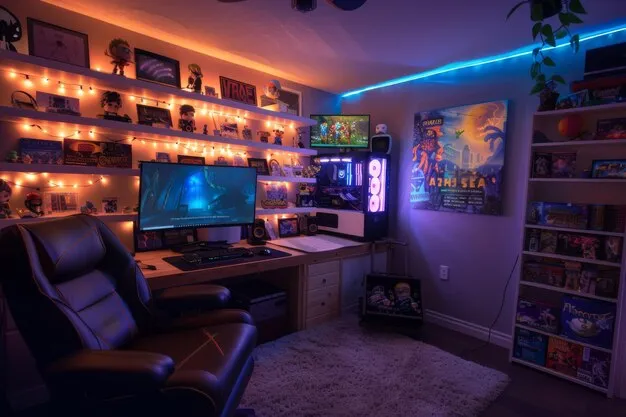
Lose on Purpose: Why Being Terrible at Video Games Might Be the Best Thing You Do for Your Mental Health

Photo: Rasheedhrasheed, CC BY-SA 4.0, via Wikimedia Commons
Somewhere along the way, gaming got competitive. Like, aggressively competitive. Leaderboards. K/D ratios. Achievement percentages. Ranked seasons. Speedrun world records posted to social media with the energy of someone announcing they've cured a disease. Gaming, which was once a hobby people did to escape pressure, somehow became another arena in which you could feel bad about yourself.
But here's a quietly radical idea: what if playing video games badly—truly, joyfully, unapologetically badly—is actually one of the best things you can do for your mental health?
I'm not being sarcastic. Stick with me.
The Performance Trap Nobody Talks About
There's a psychological phenomenon called ego depletion, which is the mental exhaustion that comes from constantly monitoring your own performance and trying to optimize outcomes. You experience it at work. You experience it in social situations. And if you're playing achievement-heavy or competitive games, you're experiencing it during what's supposed to be your leisure time, too.
The irony is brutal. You sit down to relax, and then spend two hours grinding for a platinum trophy or trying to climb a ranked ladder, and you stand up feeling more drained than when you started. That's not a gaming problem, exactly—it's a mindset problem. And it's incredibly common.
"I used to feel guilty if I wasn't making progress in a game," says Marcus, a 31-year-old teacher from Austin who has been gaming casually for about three years. "Like, if I played for an hour and didn't unlock something or beat a boss, I felt like I wasted my time. It took me forever to realize that fun doesn't have to look like progress."
Marcus isn't alone. Millions of players carry this invisible pressure into their gaming sessions without ever examining it.
What the Research Actually Suggests
Here's where it gets interesting. While the relationship between gaming and mental health is nuanced (and honestly, still being actively studied), there's meaningful evidence that the type of engagement matters enormously. Research published in journals like Computers in Human Behavior has explored how intrinsic motivation—playing because it's inherently enjoyable—is linked to greater well-being than extrinsic motivation, which is playing to achieve, win, or be recognized.
In other words: playing because it feels good is better for you than playing because you want to prove something.
This aligns with broader psychological principles around "flow states," a concept popularized by psychologist Mihaly Csikszentmihalyi. Flow happens when you're engaged in an activity that's challenging but not overwhelming—and crucially, when you're absorbed enough that self-consciousness falls away. Highly competitive gaming can actually disrupt flow by keeping your self-monitoring brain constantly activated. Low-stakes, exploratory gaming? That's flow's natural habitat.
The Case for Games That Let You Be Terrible
Not every game is designed around winning. In fact, some of the most beloved titles of the past decade are almost aggressively indifferent to whether you succeed or fail in any traditional sense. And those games, it turns out, are doing something genuinely therapeutic.
Wandering around in Minecraft with no plan is not wasting time. It's decompression. The game doesn't care if you never build anything impressive. It just keeps generating world for you to walk through.
Getting your farm completely chaotic in Stardew Valley and just... letting it be chaotic? Completely valid. The game will not punish you. Your digital crops will still grow. The villagers will still like you. There is no failure state for "didn't optimize your schedule."
Playing Journey and wandering off the obvious path to sit on a dune and watch the sand blow? That's the game. That's the whole point. There's no way to play it wrong.
"I started playing Spiritfarer during a really hard stretch," says Dani, a 27-year-old graphic designer from Portland. "It's about helping characters die peacefully, which sounds heavy, but it's the gentlest game I've ever played. I cried a lot. I also never once felt like I was failing at it. That combination was really healing for me."
Your Official 'Permission to Fail' Game List
Consider this your curated starting point for games that prioritize experience over performance. None of these will make you feel bad for playing them wrong, because there's no wrong way to play them.
- Unpacking – Arrange furniture and household items across different life stages. Zero enemies. Zero timers. Maximum coziness.
- A Short Hike – A tiny open-world game about hiking to the top of a mountain at whatever pace you want. Takes about 90 minutes. Feels like a real vacation.
- Flower – You are the wind. You blow flower petals across landscapes. That's it. It's gorgeous and wordless and deeply calming.
- Townscaper – Click to build colorful little towns on the water. There are no goals. The game just makes your towns look beautiful automatically. It's basically a stress ball with better graphics.
- Alba: A Wildlife Adventure – Play as a kid trying to save a nature reserve by photographing animals and rallying your community. It's warm, it's kind, and it has never once made anyone feel bad.
- Chicory: A Colorful Tale – A game about self-doubt and creativity where you color in the world with a giant paintbrush. Your art doesn't have to be good. The game explicitly tells you this. It's wonderful.
The Radical Act of Playing Without Keeping Score
Here's the mindset shift that ties all of this together: giving yourself permission to play without measuring the outcome is a form of self-compassion. It's choosing to engage with something for the pure experience of it, which is increasingly rare in a world that wants to quantify everything.
You don't have to be good at these games. You don't have to finish them. You don't have to tell anyone what you accomplished in them, because "accomplishment" isn't really the frame.
Jameel, a 35-year-old project manager from Chicago, put it well: "I started playing Stardew Valley just to have something to do that wasn't work or doomscrolling. I'm genuinely not good at it—I still barely understand how fishing works after 40 hours. But I look forward to it every single day. That's not nothing."
No, Jameel. That's actually everything.
The Bottom Line
Gaming doesn't owe you a trophy, and you don't owe gaming your best performance. The most subversive, mentally healthy thing you can do as a player right now might just be to load up something gentle, let yourself wander, make all the wrong choices, and enjoy every second of it.
Be bad at games on purpose. Your brain will thank you.